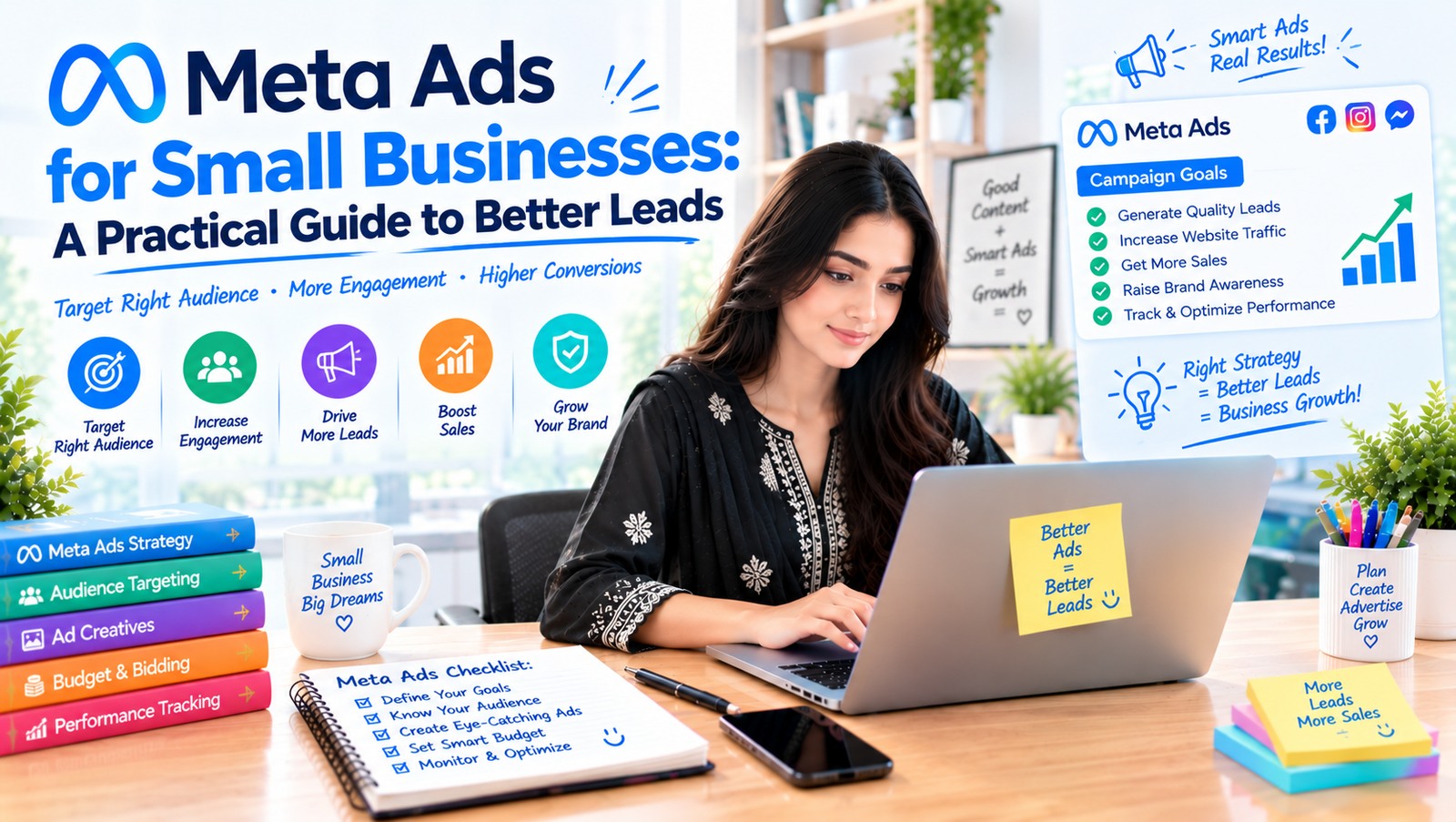
Meta advertising allows businesses to promote content and offers across supported Meta placements, including Facebook and Instagram. A successful campaign begins with a clear business outcome: qualified enquiries, purchases, bookings, or another action that creates value. Simply boosting a post because it looks popular is not a complete advertising strategy.
Paid advertising can speed up testing and reach, but it does not guarantee sales. Results depend on the offer, audience, creative, landing page, tracking, competition, and follow-up process. The aim is to build a system you can measure and improve.
1. Define the conversion you want
Before opening Ads Manager, decide what a valuable result looks like. A lead-generation business may want a qualified form submission or a WhatsApp conversation. An online shop may want a completed purchase. A local business may want calls or appointment requests.
Choose one primary conversion for each campaign. If you optimise for a low-value action such as video views while expecting sales, the campaign may find people who watch but do not buy. Awareness campaigns can be useful, but they should be judged by awareness-related outcomes rather than treated as direct-response campaigns.
Write down your target cost per result based on your margins and sales process. Do not invent a benchmark from another industry. A lead worth a great deal to one business may be unprofitable for another.
2. Understand the customer and offer
Good targeting cannot rescue an offer that is difficult to understand. Describe who the product or service is for, which problem it addresses, what makes it relevant, and what the customer should do next.
Reduce uncertainty. Explain what is included, who is suitable, how the process works, and what happens after someone enquires. If price depends on scope, say so and offer a clear way to request an estimate. Avoid misleading urgency, unsupported claims, or promises that your business cannot fulfil.
Use customer language. Review sales calls, direct messages, support questions, and testimonials for phrases people use to describe their needs. These insights can improve ad copy and landing-page messaging.
3. Choose a campaign objective that matches the goal
Campaign objectives and available options can change as Meta updates its advertising tools, so review the current Ads Manager interface before launching. The principle remains stable: choose the objective and conversion location that align with the result you want.
For website leads, make sure the form or conversion event is working and the landing page answers the ad’s promise. For messaging campaigns, prepare a prompt that helps the customer explain what they need, and assign someone to respond promptly. For online sales, verify product details, checkout usability, shipping information, and purchase tracking.
Do not split a small budget into too many campaigns and audiences before you have enough data to learn. A simpler structure can make it easier to identify what is working.
4. Develop several creative angles
Creative is more than a polished image. It is the combination of the opening message, visual, offer, proof, and call to action. Prepare a few distinct angles instead of making many near-identical versions.
Possible angles include a problem-and-solution explanation, a product demonstration, a customer question, a behind-the-scenes process, a comparison of options, or a genuine customer story. Use only testimonials and results you have permission to share, and represent them accurately.
Make the message understandable quickly. Use readable text, clear visuals, captions for video, and a direct call to action. Avoid overcrowded designs, vague claims, and tiny text that is difficult to read on a phone.
Test different concepts, not only button colours. If every version says the same thing, you may not learn much about what motivates the audience.
5. Match the landing page to the ad
An ad sets an expectation. The landing page should continue the same conversation rather than forcing the visitor to search for the promised information. Keep the headline, offer, visual language, and next step aligned.
Make the page mobile-friendly, fast enough to use comfortably, and easy to scan. Explain the service or product, show relevant evidence, answer common objections, and provide a clear contact method. Remove unnecessary form fields; collect only the information needed to respond meaningfully.
Check the full journey before spending: click the ad preview, test every link, submit the form yourself, confirm the thank-you message, and make sure the enquiry reaches the right inbox or CRM. A campaign can appear active while leads are being lost due to a broken form or notification.
6. Set a controlled budget and testing plan
Set a budget you can afford to test without putting essential business expenses at risk. The appropriate amount depends on the value of a conversion, expected conversion rate, market competition, and the time required to collect useful data.
Decide in advance what you are testing. For example, compare two creative angles while keeping the audience and offer similar. Or compare two landing-page headlines while leaving the ad unchanged. Changing everything at once makes the result harder to interpret.
Give the campaign enough time and data to produce a useful signal, while monitoring for broken tracking, irrelevant enquiries, or spend that exceeds your limits. Avoid making decisions based on a single day unless there is a clear technical or business reason to stop.
7. Measure lead quality, not just lead volume
A low cost per lead looks attractive until the team discovers that the leads are irrelevant, unreachable, or unwilling to buy. Track the entire funnel: leads received, leads contacted, qualified leads, appointments, proposals, sales, and revenue where possible.
Ask the sales team to record why leads are qualified or unqualified. Common patterns may include the wrong service, wrong location, unrealistic expectations, duplicate submissions, or missing contact details. Use the findings to improve the ad, form questions, offer, and audience.
Calculate cost per qualified lead and cost per customer when you have reliable data. These measures are often more useful than the cheapest form submission. Respect privacy requirements and only collect information needed for a legitimate business purpose.
8. Follow up quickly and consistently
Advertising creates an opportunity; follow-up helps turn it into a conversation. Assign an owner to every enquiry and define a realistic response-time target. A short acknowledgement can confirm that the message arrived, while a human response answers the customer’s actual question.
Use a simple CRM or tracking sheet to record source, requested service, contact status, next action, and outcome. Set reminders so warm leads do not disappear into an inbox. If you use automated messages, make them accurate, relevant, and easy to stop; automation should support human service rather than create unwanted messages.
Where a messaging channel is central to your market, test the journey from ad to conversation. Confirm that the opening message makes sense and that the person handling enquiries has the information needed to respond.
9. Diagnose common performance problems
If impressions are low, review delivery settings, audience size, budget, creative eligibility, and account status. If people see the ad but do not click, the message or visual may not be relevant or clear. If clicks arrive but leads do not, inspect the landing page, form, offer, load time, and tracking.
If leads arrive but do not convert, investigate lead quality, response speed, pricing clarity, sales process, and the match between the ad promise and the actual service. Do not assume every issue can be fixed by changing targeting.
Use evidence to choose the next action. Keep a short test log showing what changed, when it changed, and what happened afterwards.
10. A practical 30-day campaign workflow
Week 1: define the goal, audience, offer, budget, conversion event, and follow-up owner. Check the landing page and tracking.
Week 2: launch a small set of distinct creative concepts and monitor delivery, click quality, and technical issues.
Week 3: review lead quality and the full funnel. Pause clearly weak or broken elements, and document what you learned before making larger changes.
Week 4: refine the strongest message, improve the landing page or follow-up process, and decide whether the campaign has enough evidence to continue, expand, or be redesigned.
Frequently asked questions
Are Meta ads suitable for every business? They can suit many businesses, but success depends on audience behaviour, offer, economics, and the ability to fulfil demand. Test carefully rather than assuming the platform will work for every product or service.
How much should I spend? Start with a controlled budget based on what you can afford and the value of a qualified conversion. There is no universal budget that guarantees results.
Should I use Facebook or Instagram placements? Let the campaign goal, creative, and performance data guide the choice. Many campaigns can test multiple placements, but review where useful results actually come from.
Why do I get leads but no sales? Possible causes include poor qualification, slow follow-up, unclear pricing, a mismatch between ad and offer, or a weak sales process. Review the complete funnel.
Can I guarantee results from ads? No responsible advertiser can guarantee specific outcomes. A professional process sets expectations, measures performance, tests improvements, and reports results honestly.
Conclusion and next step
Effective Meta advertising is a measurable process, not a button to press. Start with a valuable conversion, a clear offer, creative that speaks to customer needs, a matching landing page, reliable tracking, and prompt follow-up. Improve the whole journey rather than focusing on clicks alone.
Gul Business Development can help plan and manage paid advertising around your business goals. Review your current campaign process and contact the team through the website to discuss a practical next step.
Related reading: Social Media Marketing Strategy for Small Businesses in 2026 · How to Turn Website Visitors Into Leads Using AI Automation. Our service: Paid advertising.