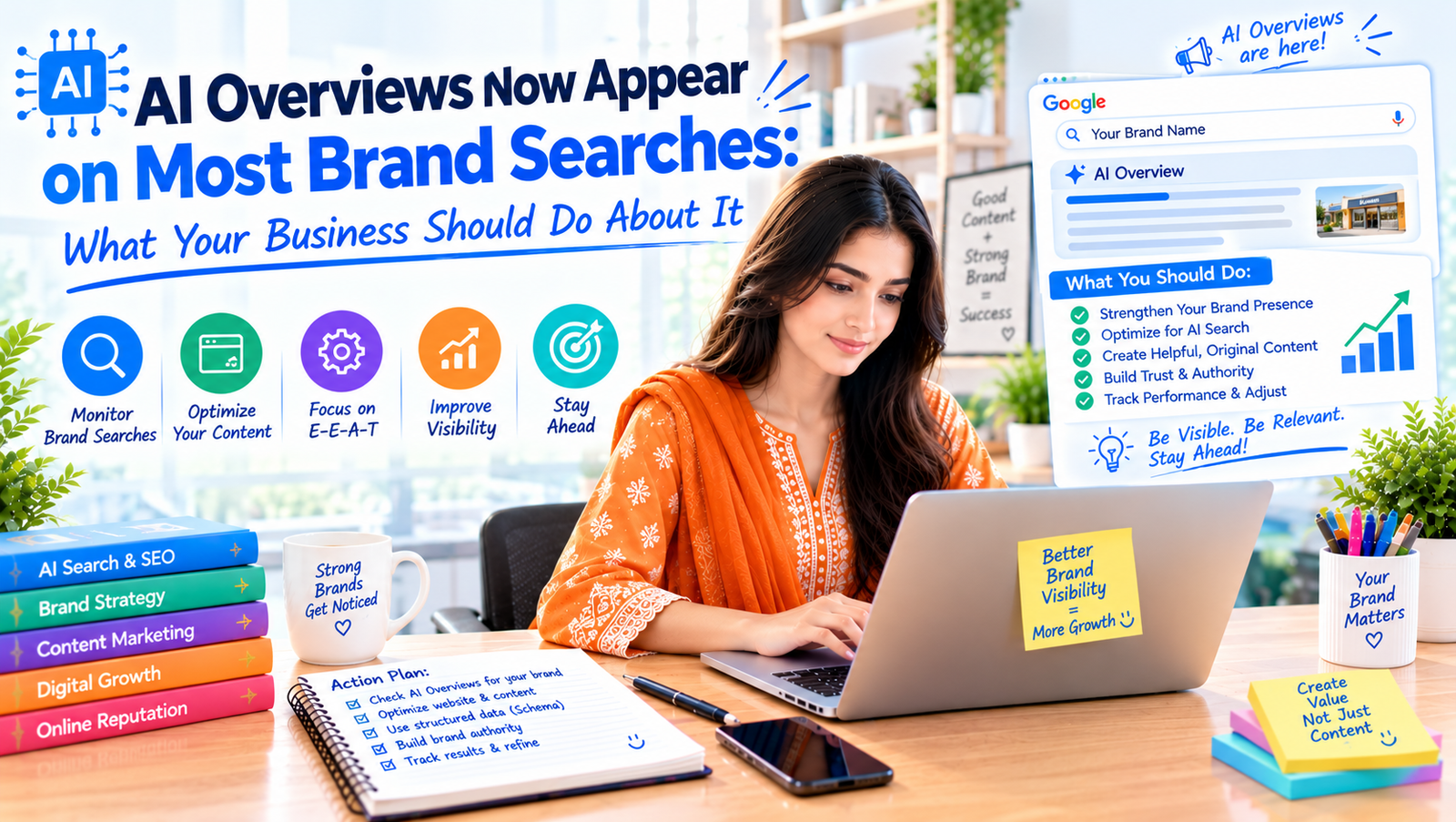
When someone types your business name into Google, there is a growing chance they will see an AI-generated summary about you before they see your website. A study by SE Ranking, reported in late October 2026, found AI Overviews on about 82.5% of US brand searches, and other coverage this month reached the same broad conclusion. The practical consequence is simple: the summary about your brand is now part of your first impression, and you can influence what it says.
Why brand searches matter more than they used to
A brand search is a high-intent moment. The person already knows your name and is deciding whether to contact you: they may be checking whether you are legitimate, what you charge, where you are, or what other customers say. If an AI summary answers those questions for them, using outdated or wrong information, you lose the sale without ever seeing the visit.
What the data does and does not say
- Scale is real, details vary. Figures differ between studies, countries and industries. Treat 82.5% as a US result for brand searches, not a promise about every query in Pakistan.
- Google is making links more visible. Reports this month describe clearer inline links and dedicated sections for official websites in AI Mode and AI Overviews. That is good news for businesses with a strong, well-structured official site.
- AI visibility is hard to measure. Kevin Indig ran 632 tests across 12 sites, discussed in a Search Engine Land article on 26 October, and could not establish a reliable link between AI visibility and later branded search or direct traffic. Be sceptical of any vendor who promises an exact return from AI visibility.
- New reporting exists, but it is partial. Search Console has added a “Web: multimodal” filter for visual search such as Google Lens and Circle to Search. It is not a dedicated AI Overviews report, so you will still need to check how your brand appears by hand.
Step 1: find out what AI says about you
- Search your business name, your name plus “reviews”, “pricing”, “contact” and “is it legit”, on a phone and on a desktop.
- Ask ChatGPT, Gemini and Perplexity the same questions in plain sentences.
- Write down what each says, what sources it uses, and anything that is wrong: old address, wrong services, missing phone number, confusion with a similarly named business.
- Repeat once a month. Keep the notes in a spreadsheet so you can see change.
Step 2: fix the sources, not the summary
AI systems assemble answers from sources they can read and trust. You cannot edit the summary directly, but you can fix what feeds it.
- Your own website. Have a clear About page, a contact page with your full address and phone, and a dedicated page for each service. State plainly what you do, where, and for whom.
- Structured data. Add Organization or LocalBusiness schema with your correct name, address, phone, social profiles and services. Keep it matching the visible page.
- Google Business Profile. Claim and complete it, with categories, hours, photos and services. Respond to reviews.
- Consistent details everywhere. Use the same business name, address and phone on Facebook, LinkedIn, directories and your website.
- Answer brand questions on your site. A short FAQ covering pricing approach, process, delivery areas and how to contact you gives both people and AI systems something accurate to quote.
- Reviews and mentions. Independent reviews, press mentions and partner pages give AI systems corroboration beyond your own claims.
Step 3: keep the SEO foundation healthy
AI Overviews draw on Google’s index. If your pages are slow, thin, blocked or poorly linked, no amount of AI-specific work will help. Fast pages, clear internal links and original content still come first. Our guide on GEO vs SEO explains how the two fit together, and how to get recommended by ChatGPT, Gemini and Google AI covers the content side.
Step 4: decide what you want from the click
If AI summaries answer more questions, fewer people click through, so the people who do arrive are often further along. Make sure your pages reward them: a clear next step, a visible phone or WhatsApp button, and proof such as reviews and examples of your work. Measure enquiries, calls and WhatsApp messages, not only visits.
Mistakes to avoid
- Stuffing the site with pages that repeat your brand name in the hope of being quoted.
- Buying “AI visibility” packages that promise guaranteed mentions.
- Ignoring wrong information because “it is only a summary”.
- Publishing mass-produced AI content. Google’s spam guidance covers this, as we explained in our note on the September 2026 spam update.
Frequently asked questions
Can I turn AI Overviews off for my brand?
Not directly. Google offers controls such as snippet and robots directives, but blocking them also limits how your pages appear in Search. For most businesses, being represented accurately is better than being hidden.
Why does the AI summary show wrong information about my business?
Usually because it reflects conflicting or outdated sources. Fix the sources, such as your website, Google Business Profile and directory listings, and the summaries tend to follow, though not instantly.
Is this only a problem for big brands?
No. Small businesses with a distinctive name often have thin information online, so a few accurate, consistent pages can have a large effect.
The short version
Your brand name is now an AI search query. Check what is said about you, fix the sources behind it, keep your SEO foundation healthy, and measure enquiries rather than impressions.
We help businesses do exactly this through our SEO services. To see how your brand appears today, ask for a free audit.
This article reflects what was publicly reported up to 28 October 2026. Platforms change quickly, so check the official source before you act.