
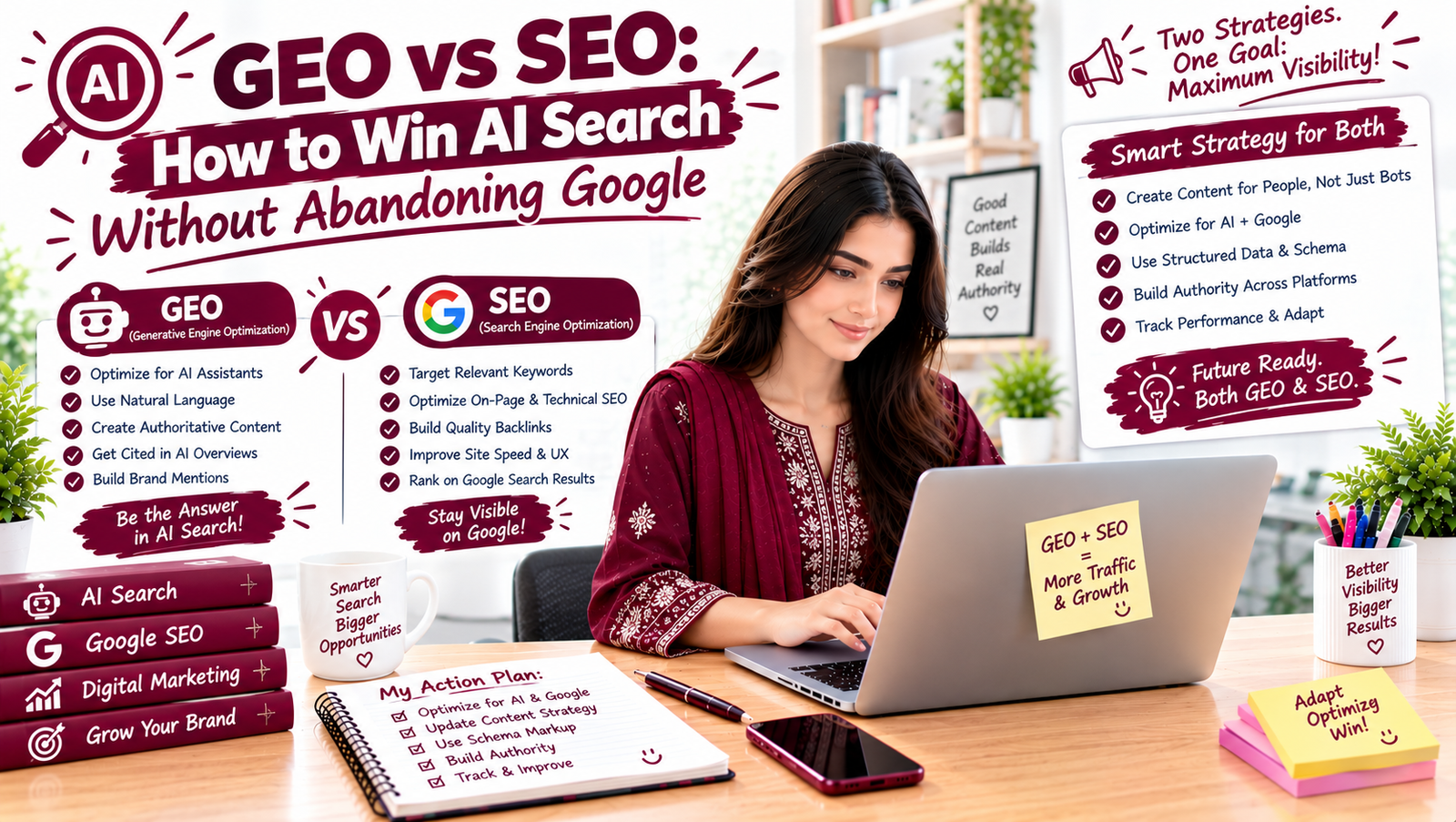
GEO and SEO are not alternatives. SEO makes your website discoverable, crawlable and rankable. GEO — Generative Engine Optimisation — improves the chance an AI system understands and references your brand when it writes an answer. GEO sits on top of SEO, and without the SEO foundation underneath it there is nothing for it to sit on.
For years the question was simply how to rank higher on Google. That still matters. But a second question has arrived alongside it: how does my business appear when a customer searches using AI?
Customers can now ask a full question instead of typing three words. “I own a small e-commerce business. Which digital marketing strategies should I use to increase organic traffic, generate leads and cut my advertising costs?” The system replies with a summary, some recommendations, and sometimes sources.
That changes how you think about visibility. It does not mean SEO is dead. Google’s own guidance for its AI search features is explicit that ordinary SEO best practice still applies, while warning against low-value content produced at scale to manipulate rankings.
What SEO covers
SEO is the work of making a website easy for a search engine to discover, crawl, understand, index and rank. In practice it splits into five areas.
- Technical — crawling, indexing, site architecture, mobile usability, page speed, Core Web Vitals, HTTPS, sitemaps, canonicals, redirects
- On-page — search intent, titles, heading structure, content, internal links, images and alt text, metadata
- Off-page — backlinks, digital PR, brand mentions, industry coverage, partnerships
- Local — Google Business Profile, reviews, location pages, consistent business information
- E-commerce — product pages, product information, categories, merchant feeds, product structured data
What GEO covers
GEO asks a different question. Not “can I rank this page?” but “can an AI system understand, trust and reference my brand when it builds an answer?”
The work is broader than a page: brand information, entity consistency, topical depth, expertise, original research, structured information, reviews, local signals, digital mentions and genuinely helpful answers. It is one of the fastest-growing requests agencies are getting from clients, and a large share of that demand is people who have heard the term and want to know whether it changes anything for them.
The difference, side by side
| SEO | GEO | |
|---|---|---|
| Stands for | Search Engine Optimisation | Generative Engine Optimisation |
| Where it shows up | Search results pages | AI-generated answers |
| The win condition | A ranking | A mention, a citation, or inclusion in the answer |
| Unit of work | The page | The whole information ecosystem around the brand |
| Research focus | Keywords, still useful | Topics, intent and the question behind the question |
| Authority comes from | Links and page quality | Brand recognition and external references |
| Main outcome measured | Clicks and traffic | Visibility, mentions, assisted conversions |
The table makes them look separate. In practice they overlap almost completely, which is the next point and the important one.
Why SEO is the thing that makes GEO possible
Some businesses hear about AI search and conclude they can stop doing SEO. That is the expensive version of this mistake.
If your site is slow, confusing, hard to crawl, full of duplicate pages, missing basic information and thin on useful content, adding the phrase “AI search optimisation” to it changes nothing. The order runs like this:
- Technical SEO — the site can be read at all
- Content and search intent — the site answers real questions
- Topical authority — the site covers a subject properly, not once
- Brand authority — the business is recognisable
- External mentions — other credible sources refer to it
- AI search visibility — the outcome of all five
You do not throw away an SEO strategy to do GEO. You extend it.
Keywords still matter, just not on their own
“Keywords don’t matter anymore” is too strong. A keyword still tells you what people are looking for. Take AI automation for small business. That phrase identifies the topic. But the person typing it also wants to know what AI automation is, which tasks can be automated, what it costs, whether it can handle lead follow-up, whether it connects to a CRM, what the risks are and which tools exist.
Cover the topic and you cover the keyword. Cover only the keyword and you cover neither.
Intent matters more when the question is a sentence
| Intent | What it sounds like |
|---|---|
| Informational | What is SEO? |
| Commercial | Best SEO agency for a small business |
| Transactional | Hire an SEO agency |
| Problem-based | Why is my website getting no traffic? |
| Comparative | SEO vs Google Ads |
| Conversational | I have a small business and almost no organic traffic. What should I do? |
That last row carries far more context than the others, and it is the shape most AI queries take. Write for the problem behind the question and you serve all six.
The content structure that works: answer, then depth
Five steps, in this order: answer directly, explain the context, demonstrate with an example, support it with evidence or experience, then give the next step.
This beats writing three thousand words because someone said long content ranks better. Length is not the goal. Being useful is the goal, and being useful in the first paragraph is what makes a page quotable.
Why bulk AI content is not a GEO strategy
AI is genuinely useful for research and first drafts. Publishing hundreds of unedited pages is a different activity, and Google’s spam guidance names scaled content abuse specifically: large volumes of unoriginal content produced mainly to manipulate rankings rather than help anyone.
Compare two sites. One publishes 500 generic articles with no original data, no case studies, no expert input. The other publishes 50 researched articles with real examples, customer case studies, industry data, named authors and proper internal linking. The second one has something to build on. The first has a maintenance problem.
GEO runs on brand authority
Traditional SEO asks which page should rank. GEO increasingly asks which source should be trusted. That makes the brand itself part of the work.
If you claim to specialise in AI automation, your footprint should support the claim: a service page, guides, workflow examples, case studies, videos, social posts and mentions elsewhere. One page claiming expertise is an assertion. Ten touchpoints demonstrating it is evidence.
Say what you do in plain words
“We transform brands through next-generation growth ecosystems” sounds impressive and communicates nothing. Compare: “we help businesses increase online visibility, generate qualified leads and automate repetitive marketing work through SEO, paid advertising, social media, web development and AI automation.”
The second version is what a customer understands and what a machine can summarise. Clarity is not a downgrade from clever writing. It is the requirement.
Clusters instead of random posts
If your main service is SEO, do not publish “10 marketing tips”, “social media trends” and “best business tools” in the same month. Build the ecosystem instead: a pillar SEO services page, then guides on technical, on-page, local, international and e-commerce SEO, image and video SEO, search intent, internal linking, Core Web Vitals and AI search. Link them to each other.
Do the same for each service you actually sell — paid advertising, AI automation, websites and e-commerce, social media management.
Make the answer easy to extract
Two small habits do most of the work here. First, put the definition in the opening lines rather than five paragraphs down. Second, use headings that match the question: “What is GEO?” rather than “Understanding the Future of Search”; “How is GEO different from SEO?” rather than “A New Era of Digital Discovery”.
Clear headings help people scan and help machines find the relevant section. Clever headings help nobody.
Use specific examples and real experience
“Businesses can use AI to improve marketing” is filler. “A local service business can use a chatbot to answer common questions, collect contact details, qualify the enquiry and pass high-intent leads to a salesperson” is an explanation.
Where you have genuine first-hand experience, use it — “in website conversion audits, the pattern we see most often is…”. Where you do not, do not manufacture it. Invented experience is the fastest way to lose the trust the whole strategy depends on.
Digital PR matters more, not less
Your site saying you are an expert is an advertisement. Someone else saying it is a reference. Look for legitimate opportunities: industry interviews, podcasts, expert contributions, business publications, partnerships, relevant directories, local media, webinars.
GEO does not mean ten thousand backlinks. Relevance, credibility and editorial context beat volume. Bought links in bulk create risk without creating recognition.
Local and e-commerce businesses need both
Someone asking “what are the best digital marketing agencies in Islamabad for a small business” is asking a local question in a conversational way. A generic website cannot answer it. You need location information, service pages, local content, claimed profiles, reviews, consistent contact details and local case studies.
For an online store the same principle applies to products. Complete product information — name, description, features, price, availability, images, variants, reviews, specifications — plus supporting content around it. For a soap brand that might mean a guide to choosing a soap for your skin type, an ingredients guide, and how to use handmade soap, all linking back to the product pages.
Images and video are part of this
AI-driven search is not text-only. Google’s guidance for generative search discusses local, shopping, image and video content alongside traditional practice. That means original photography, infographics, tutorials, demonstrations and case-study videos are all in scope — and all of them need proper titles, alt text and descriptions.
How to measure it
Keep your existing metrics: impressions, clicks, rankings, click-through rate, organic traffic. Then add a monthly manual check. Take ten questions a real customer would ask, run them through the AI tools your market uses, and log whether your brand was mentioned, which competitors appeared, whether anything was cited, and how your company was described.
It is a spreadsheet and twenty minutes a month. That turns GEO from a trend into something you can actually track.
A 90-day SEO and GEO plan
Month 1: fix the foundation
Technical SEO, site structure, service pages, About page, Contact page, consistent business information, internal linking, structured data, Search Console, analytics, local profiles. Goal: the business is technically accessible and understandable.
Month 2: build topical authority
Two to four pillar pages, the supporting articles around them, FAQs, the first case studies and anything original from your own work. Link them properly. Goal: become a useful source in your niche.
Month 3: build authority elsewhere
Digital PR, industry mentions, expert contributions, social content, video, reviews, partnerships, case-study promotion, and the first AI visibility log. Goal: recognition beyond your own domain.
Eight mistakes worth avoiding
- Abandoning SEO because GEO sounds newer
- Publishing AI content at scale — more pages is not more authority
- Optimising for keywords while ignoring the customer’s problem
- Treating reputation as someone else’s job; AI visibility is not only about your website
- Having nothing original — generic content is trivially replaceable
- No case studies, so every claim stays a claim
- No external authority, so your site is your only witness
- Chasing visibility without tracking conversions
Visibility is only half of it
Plenty of businesses ask how to appear in AI search and never ask what happens next. Once someone finds you, the site has to let them understand the service, see proof, compare options and make contact without friction.
Search, AI discovery, brand awareness, a website visit, trust, contact, follow-up, customer. Visibility that stops at the first step is a vanity metric. We wrote about the second half in turning website visitors into leads with AI automation.
Frequently asked questions
Should I invest in SEO or GEO?
SEO first, then extend into GEO. If your site has technical problems, weak content and unclear services, fix those before chasing AI visibility. If the foundation is already solid, start on conversational content, brand visibility, original research, digital PR and AI visibility tracking.
Is GEO a real discipline or just a new label?
Some of it is genuinely new — entity consistency, monitoring how AI systems describe you, writing so answers can be extracted cleanly. A good deal of it is SEO and PR fundamentals under a newer name. Be sceptical of anyone selling GEO as something entirely separate from the work you should already be doing.
What is AEO, and where does it fit?
Answer Engine Optimisation is the narrower craft of structuring a page so a clear answer can be lifted from it: a direct definition, question-shaped headings, short paragraphs, real FAQs. It is a component of both SEO and GEO rather than a third strategy to resource separately.
How do I know if any of it is working?
Traditional metrics move first: impressions and rankings in Search Console. AI visibility shows up in your monthly log, and it moves more slowly. The real answer is enquiries — if visibility rises and enquiries do not, the problem has moved to your website, not your search strategy.
The short version
Customers no longer use one search box. The same buying journey can pass through Google, AI answers, YouTube, social media, maps, reviews and communities. SEO remains the foundation. GEO extends your visibility into generative search. Businesses that do both build something more durable than businesses chasing rankings alone.
Not sure which half you are missing? Send us your website and we will tell you where the gap actually is — foundation, content or authority. Get a free audit, or message +92 342 893 2959 on WhatsApp.